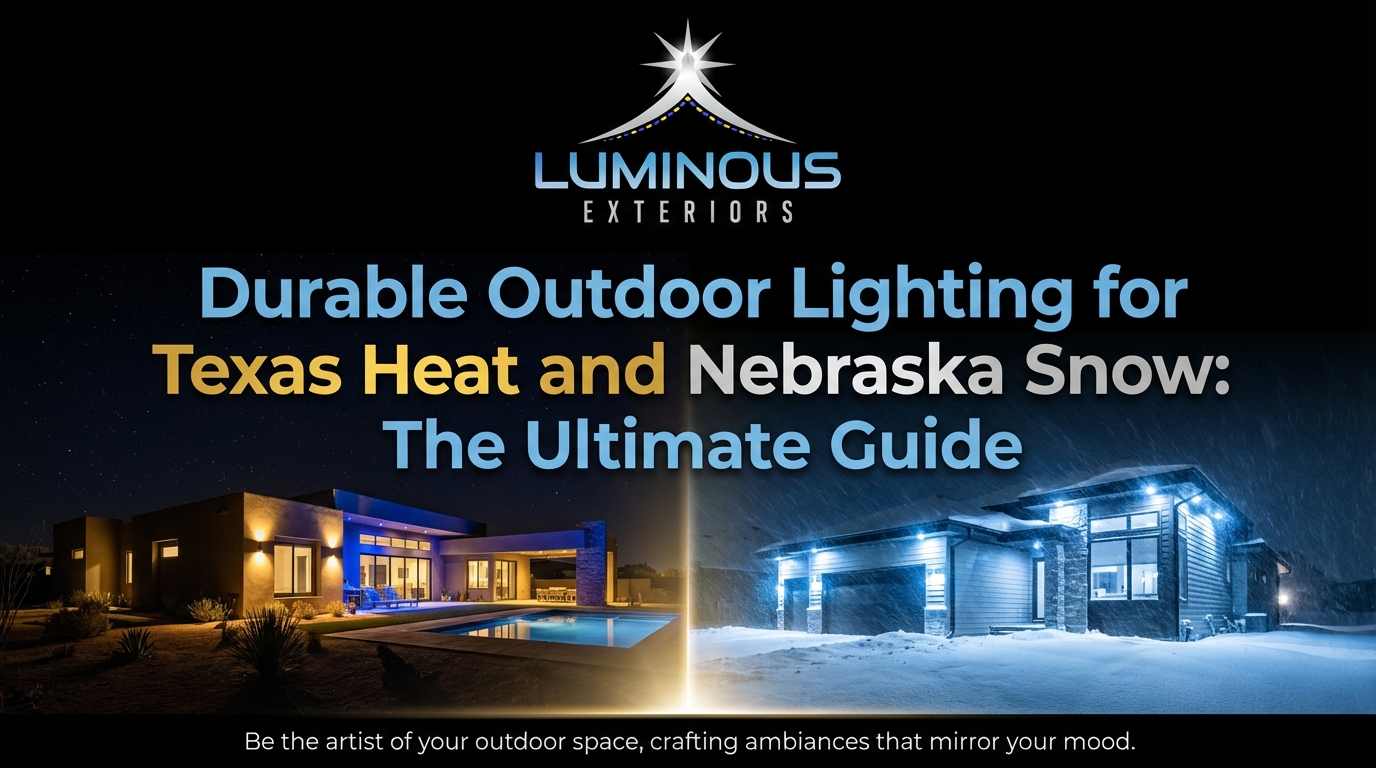
Durable Outdoor Lighting for Texas Heat and Nebraska Snow: The Ultimate Guide
Durable Outdoor Lighting for Texas Heat and Nebraska Snow: The Ultimate Guide
Investing in outdoor lighting is about more than just aesthetics; it is an investment in security, ambiance, and the long-term value of your property. However, for homeowners in regions with extreme weather conditions—specifically the blistering heat of Texas summers and the freezing, snowy winters of Nebraska—standard lighting solutions often fall short. The physical demands placed on exterior fixtures in these climates are intense, ranging from UV degradation and thermal shock to ice expansion and salt corrosion. Choosing the wrong materials can lead to faded finishes, cracked lenses, and system failures within just a few seasons.
At Luminous Exteriors, we understand that a lighting system must be as resilient as it is beautiful. Whether you are illuminating a patio in Dallas or a driveway in Omaha, the principles of durability remain the same: superior materials, precise engineering, and professional installation. This guide dives deep into the technical requirements for outdoor lighting that can withstand the dual extremes of scorching heat and sub-zero cold, ensuring your landscape remains brilliantly lit year-round.
In this comprehensive article, we will explore the specific challenges posed by these contrasting climates and provide a detailed roadmap for selecting fixtures that last. We will compare materials like brass and aluminum, analyze the limitations of solar technology in extreme weather, and break down the technical specifications—such as IP ratings and Kelvin temperatures—that matter most. By the end, you will have the knowledge to make an informed decision that mirrors your mood and protects your investment.
Quick Answer: What is the Best Outdoor Lighting for Extreme Climates?
The most durable outdoor lighting for extreme heat and cold utilizes solid brass or copper fixtures rather than aluminum or plastic. These materials naturally resist corrosion and do not rely on coatings that peel under UV exposure. For performance, choose hardwired low-voltage LED systems with a minimum rating of IP65 (waterproof) and thermal management heat sinks. Avoid solar lights in these climates, as battery chemistries often fail in freezing temps and high heat degrades solar panels.
1. The Challenge of Dual-Extreme Climates
Most outdoor lighting manufacturers design their products for "average" conditions, typically tested in moderate climates. However, Texas and Nebraska represent the edges of the weather spectrum, often subjecting fixtures to a punishing cycle known as thermal shock. In Texas, surface temperatures on dark metal fixtures can easily exceed 150°F under direct sunlight. In Nebraska, winter nights can drop well below zero. If a fixture is installed in a location that experiences both high heat in summer and deep freeze in winter, the materials are constantly expanding and contracting.
This constant movement is the enemy of cheap manufacturing. Thermal expansion can compromise the gaskets that seal the lens, allowing moisture to enter. Once water gets inside, the freeze-thaw cycle in Nebraska will turn that moisture into ice, expanding and cracking the housing or shattering the glass lens. Conversely, in Texas, extreme heat can dry out rubber seals, causing them to become brittle and crumble, leading to the same result: water ingress and system failure.
Furthermore, the soil itself behaves differently in these regions. In Nebraska, the frost line—the depth to which the groundwater in soil freezes—can reach 40 inches or deeper. This causes "frost heave," where the ground physically lifts up, potentially uprooting shallow-buried wires or shifting fixtures out of alignment. In Texas, clay-heavy soils often shrink and crack during droughts, putting mechanical stress on underground wiring. Understanding these environmental mechanics is the first step in designing a system that endures.
2. Material Selection Guide: Why Brass and Copper Outperform Aluminum
The Failure Points of Aluminum
Aluminum is the most common material used in big-box store lighting because it is lightweight and cheap to manufacture. However, aluminum naturally oxidizes (rusts) into a white powder when exposed to moisture. To prevent this, manufacturers apply a powder coating or paint. In the intense UV radiation of a Texas summer, this coating inevitably breaks down, fades, or chalks. Once the coating is compromised—even by a microscopic scratch from a weed eater—moisture enters, oxidation spreads underneath the paint, and the finish bubbles and peels off. In coastal areas or regions using road salt, this process accelerates rapidly.
The Patina Advantage of Brass and Copper
For long-term durability, solid cast brass and copper are the gold standards. Unlike aluminum, these metals are semi-precious and do not rely on a powder coating for protection. When exposed to the elements, brass and copper undergo a natural chemical reaction that creates a "patina"—a thin layer that actually protects the metal from further corrosion. This living finish means your fixtures will darken beautifully over time, blending organically into the landscape rather than looking like worn-out trash.
Marine-Grade Stainless Steel
For a modern aesthetic that withstands corrosion, 316 marine-grade stainless steel is an excellent alternative, particularly for Nebraska homes exposed to road salts or Texas homes near the humid Gulf Coast. It is crucial to verify that the steel is grade 316, not the cheaper 304 grade. Grade 316 contains molybdenum, which significantly increases corrosion resistance. However, be aware that even stainless steel requires occasional cleaning to maintain its luster, whereas brass can largely be left alone to age gracefully.
3. The Heat Factor: Features for Texas Summers
UV Resistance and preventing "Chalking"
The Texas sun is relentless. UV radiation attacks the chemical bonds in plastics and paints. Cheap plastic fixtures made of ABS (Acrylonitrile Butadiene Styrene) will yellow and become brittle, eventually cracking under minor impacts. Polycarbonate is stronger but still susceptible to yellowing over years. The best defense is avoiding plastics entirely for the housing. For lenses, high-quality borosilicate glass or heat-tempered glass is impervious to UV damage and will remain clear for the life of the fixture.
Thermal Management for LED Longevity
While LEDs run cooler than halogen bulbs, they still produce heat at the driver and chip level. In an ambient temperature of 105°F, a poorly designed fixture can trap internal heat, causing the LED electronics to overheat and fail prematurely. High-quality fixtures for hot climates feature engineered heat sinks—metal fins or heavy brass bodies that physically draw heat away from the LED chip and dissipate it into the surrounding air. This thermal management is critical for ensuring your LEDs reach their rated 50,000-hour lifespan.
Color Temperature and Insect Resistance
A unique challenge in Texas summers is the prevalence of insects. Lights that emit high amounts of blue light (cool white, 5000K+) act as beacons for mosquitoes, moths, and other pests. To minimize insect swarms around your patio or entryways, opt for warmer color temperatures. A Kelvin rating of 2200K to 2700K (warm white) is much less visible to insects while creating a cozy, inviting ambiance. Some specialized "bug lights" go even lower, but a standard warm white is usually sufficient to reduce the attraction significantly without sacrificing aesthetics.
4. The Cold Factor: Features for Nebraska Winters
Instant-On Performance in Sub-Zero Temps
Old-school lighting technologies like Fluorescent or HID (High-Intensity Discharge) often struggle to start in freezing weather, flickering or taking minutes to warm up. LEDs are solid-state semiconductors, meaning they function exceptionally well in the cold. In fact, LEDs are generally more efficient in cold weather because heat dissipation is naturally handled by the environment. For Nebraska winters, this instant-on capability is a safety necessity, ensuring your pathways and driveways are illuminated the moment you need them, regardless of the temperature drop.
Vulnerability of Plastics to Embrittlement
As temperatures drop, materials lose ductility. Cheap plastic composite stakes used to anchor path lights are notorious for snapping off at the ground level when bumped by a snow shovel or stepped on. In Nebraska, it is vital to use fixtures with metal stakes—preferably brass or stainless steel. These can withstand the accidental impacts of snow removal equipment and the pressure of frozen soil without shattering.
Resisting Salt Corrosion
In Nebraska, de-icing salts used on roads and driveways create a corrosive saline mist that settles on low-level lighting fixtures. This is chemically similar to the conditions found at a beach house. Aluminum fixtures will corrode rapidly in this environment, often seizing up screws so they cannot be removed for bulb changes. Using brass fixtures with silicone grease applied to all threaded connections is the best defense against salt-induced corrosion and seizing.
5. Power Source Analysis: Why Hardwired Low-Voltage Beats Solar
Battery Chemistry Failures
Solar lights rely on batteries to store energy, typically Nickel-Metal Hydride (NiMH) or Lithium Iron Phosphate (LiFePO4). Both chemistries have severe limitations in extreme temperatures. In intense Texas heat, batteries degrade rapidly, losing their capacity to hold a charge. In freezing Nebraska winters, chemical reactions within the battery slow down, causing the light to run for only an hour or two before dying—exactly when you need light the most during long winter nights.
Snow Cover and Panel Degradation
Beyond battery issues, solar panels need direct line-of-sight to the sun. In Nebraska, a single snowfall can cover the small solar panels on path lights, rendering them useless until the snow melts or is manually cleared. Furthermore, the UV exposure in Texas eventually clouds the epoxy coating on cheap solar panels, reducing their efficiency. Hardwired low-voltage systems draw power directly from your home's consistent electrical supply, guaranteeing performance regardless of cloud cover, snow accumulation, or battery age.
6. Technical Specs Explained: Minimum IP Ratings and IK Ratings
When shopping for durable lighting, you will encounter technical acronyms. Understanding these is key to verifying quality.
IP Ratings (Ingress Protection)
The IP rating consists of two numbers. The first digit (0-6) refers to dust protection, and the second (0-9) refers to water protection. For outdoor lighting in Texas and Nebraska, you should accept nothing less than IP65.
IP65: Dust tight and protected against water jets from any angle. Suitable for most general landscape lighting.
IP67: Dust tight and protected against temporary immersion in water. This is critical for in-ground well lights that might be submerged during a heavy Texas thunderstorm or melting Nebraska snow.
IK Ratings (Impact Protection)
The IK rating measures protection against mechanical impact, which is relevant for hail in Texas or falling ice in Nebraska. An IK08 or higher rating indicates the fixture can withstand significant impact (equivalent to a 1.7kg mass dropped from roughly 30cm) without breaking. This durability ensures your lights survive the chaotic weather of the Midwest and South.
7. Installation Best Practices: Wiring Depth and Sealants
Combating Frost Heave and Soil Movement
In Nebraska, professional installers must account for the frost line. While low-voltage wire doesn't need to be buried 4 feet deep, the fixtures themselves must be anchored securely. Using longer stakes or concrete anchors prevents the lights from heaving out of the ground. In Texas, where clay soil cracks, leaving "slack" or expansion loops in the wire at each fixture is crucial. This extra wire allows the soil to shift and move without pulling the connection apart.
Waterproofing Connections
The most common failure point is not the light, but the wire connection. Standard wire nuts are insufficient for underground use. You must use waterproof connectors filled with silicone sealant or heat-shrink tubes with adhesive lining. This prevents water from wicking up into the wire strands, which can corrode the copper conductor and cause voltage drops or system outages years down the road.
8. Maintenance Checklist: Seasonal Transitions
Even the most durable systems benefit from seasonal care. Here is a quick checklist for transitioning between extremes:
Fall (Pre-Winter): Clean lenses of dirt and leaves to ensure maximum brightness. Apply a thin layer of silicone grease to any exposed screws to prevent seizing from road salt. Check fixture aim to ensure snow plows won't hit them.
Spring (Post-Winter): Inspect for frost heave damage and re-seat any tilted fixtures. Rinse off salt residue with fresh water. Check exposed wires for rodent damage (hungry critters often chew wires in winter).
Summer (Pre-Heat): Trim rapidly growing vegetation that might obscure lights or cause overheating by blocking airflow. Check for insect nests inside shrouds.
The Luminous Resilience Audit: How to Vet Your Fixtures
Before you purchase any lighting for your home, run it through the "Luminous Resilience Audit." If a fixture fails more than one of these checks, it is likely to fail in Texas or Nebraska climates:
Checklist Item Why It Matters Magnet Test Take a magnet to the fixture. If it sticks, it contains ferrous metal (steel/iron) that will rust. Brass and copper are non-magnetic. Weight Test Heavy fixtures usually indicate solid cast metal and better heat sinking. Light fixtures are often thin aluminum or plastic. Sealed LED vs. Drop-in Integrated LED modules often have better heat dissipation than drop-in bulbs, but ensure the warranty covers the whole fixture (5+ years). Wire Lead Quality Look for thick, round, UV-rated wire leads. Thin, flat wire often indicates cheap internal components.
Conclusion: Light That Lasts
Lighting your home in Texas or Nebraska is a battle against the elements, but it is a battle you can win with the right equipment. By prioritizing materials like brass and copper, understanding the mechanics of thermal shock, and insisting on professional-grade installation standards, you can create an outdoor sanctuary that withstands the test of time.
At Luminous Exteriors, we don't just install lights; we engineer ambiances. We select components that have been battle-tested in these specific climates to ensure that when you flip the switch, the magic happens—every single time.
Ready to Illuminate Your Home for the Long Haul?
Don't let the weather dictate your curb appeal. Whether you need heat-resistant patio lighting or freeze-proof security lights, Luminous Exteriors is your partner in permanent, premium outdoor lighting.


